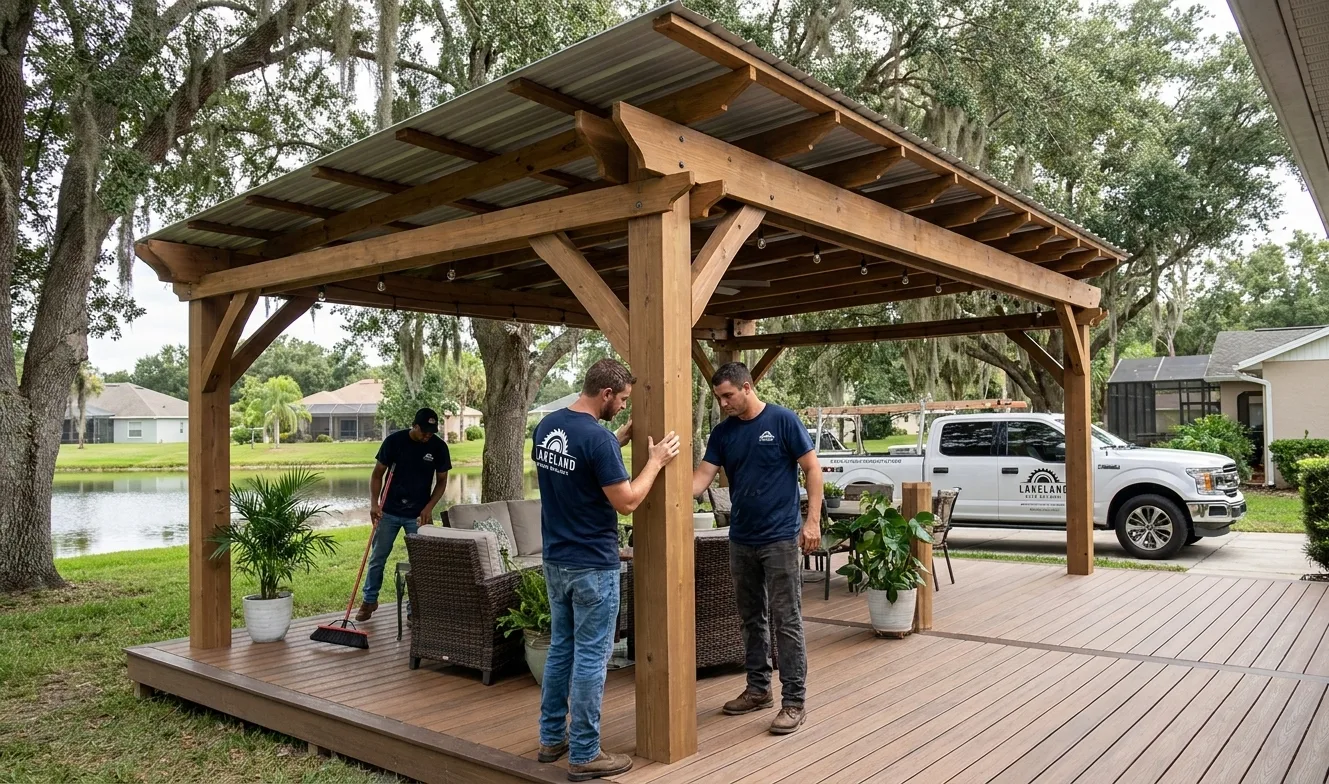
Common Pergola Sizes and What They Fit
Most of the pergolas and covered decks we build in the Lakeland area fall into a few standard footprints:
- 10×10: A compact size that comfortably covers a small bistro table and two to four chairs, or a couple of lounge chairs. Good for smaller yards or a cozy reading nook off a side door.
- 12×14: Our most popular size. Fits a standard six-person outdoor dining set with room to walk around it, plus a bit of extra space for a side table or planter.
- 16×20: A full outdoor living footprint — dining area, a seating group, and often a grill station or outdoor kitchen along one edge, all under one shaded structure.
- 20×20 and larger: Typically reserved for larger lots or pool-adjacent builds where the pergola needs to shade both a dining area and a separate lounge zone.
Sizing Around Your Furniture
The simplest way to land on the right size is to work backward from the furniture you actually plan to put underneath it. A standard six-person rectangular dining table needs roughly 8×10 feet of clear space once you account for pulling chairs out, which typically calls for at least a 12×12 structure once you add a comfortable buffer at the edges. For a lounge seating arrangement (a sofa, two chairs, and a coffee table), plan on a minimum of 12×14. We recommend measuring your actual furniture, or the pieces you're planning to buy, and adding at least 3 feet of clearance on all sides so the space doesn't feel cramped.
Shade Coverage vs. Sun Angle in Florida
Florida's sun sits much higher overhead at midday than in northern climates, which changes how much real shade a given pergola size provides. A traditional open-slat pergola lets a good amount of light through even at a generous size, since the sun angle allows light to pass between slats for several hours each day. If your priority is genuinely blocking sun rather than just adding architectural interest, consider a solid or louvered roof panel, woven shade cloth, or a full screened deck enclosure instead of an open lattice top. We walk every homeowner through how their specific yard's orientation — north-facing, south-facing, tree cover — affects real-world shade before finalizing a design.
Freestanding vs. Attached Pergolas
An attached pergola, built off the back of the house, is generally the more cost-effective option because it ties structurally into the home's existing framing on one side, reducing the number of independent posts and footings needed. A freestanding pergola stands entirely on its own four (or more) posts and footings, which costs somewhat more but offers real flexibility — it can shade a pool area, sit at the edge of a patio, or anchor an outdoor kitchen away from the house entirely. For lakefront lots where the best view isn't directly behind the house, freestanding is often the better fit.
PAA: Pergola Sizing for Florida Backyards
What is a good size for a backyard pergola?
For most Lakeland homeowners, 12×14 hits the sweet spot: large enough for a full dining set with breathing room, without overwhelming a standard suburban backyard. Smaller 10×10 structures work well for tighter lots or a secondary seating nook.
Should my pergola be attached or freestanding?
Attached is usually the more budget-friendly choice when the space directly behind your home works for your layout. Freestanding makes more sense when you want to shade a pool area, a spot farther from the house, or a location with a better view.
How much shade will a pergola actually give me?
An open-slat design provides partial, dappled shade rather than full coverage. If you want to genuinely block midday Florida sun, ask about a louvered or solid roof insert, or consider a screened deck for full coverage plus bug protection.
Get a Design Sized for Your Yard
Every pergola and covered deck we build starts with an on-site measurement of your actual yard, sun exposure, and how you plan to use the space — not a one-size-fits-all package. If you're weighing a pergola against a fully screened deck enclosure, we'll walk you through the tradeoffs during your free estimate.
Ready to plan your layout? Request a free estimate or call (863) 524-9934.